In modern life, we’re surrounded by a variety of light sources every day, from monitors on our desks to lighting fixtures in our homes. However, have you ever experienced visual fatigue, dry eyes, or even headaches caused by lighting ? This isn’t likely due to insufficient lighting, but rather the “light violence” of glare.
Glare refers to the phenomenon of visual discomfort and reduced visibility caused by objects with extremely high brightness or strong brightness contrast in the field of vision. It is like an invisible knife that weakens your vision and accelerates eye fatigue.
Fortunately, this problem doesn’t require replacing the entire lamp. A seemingly simple component— an anti-glare lampshade —can fundamentally solve the problem. This article will delve into the harmful effects of glare and reveal how anti-glare lampshades, using scientific principles, can become your preferred eye protection .
Two forms of glare: direct and reflected, each with different hazards
To understand how anti-glare light covers work, it’s important to first differentiate between the two main types of glare.
Discomfort glare
This is the most common type of glare, usually caused by the light source itself, and causes visual physiological discomfort.
Cause: Looking directly at the light bulb or the extremely bright surface of the lampshade .
Symptoms of harm: Causes eye fatigue and discomfort, and makes people want to squint or avoid light sources, but does not immediately affect the viewing of objects.
Elimination key points: Mainly through the shading angle of the lampshade and the soft light diffusion function to reduce the apparent brightness of the light source.
Disability glare
This type of glare is more harmful. It will seriously affect the eye’s ability to recognize details and directly damage visibility.
Cause: Light is reflected from a non-smooth surface (such as a desk or computer screen) and enters the eye.
Harm manifestations: The eyes receive interfering light, which reduces the retina’s ability to perceive contrast and makes it difficult to see the details of objects.
Eliminate emphasis: Anti-glare lampshades need to ensure that light is projected evenly to avoid overly bright spots or specular reflections .
The core secret of anti-glare lampshade: UGR value and five principles
The Unified Glare Rating (UGR) is an international standard for measuring the glare level of a lighting environment . The lower the UGR, the less glare and the more comfortable the lighting. Generally speaking, office lighting should be below UGR 19, while a more comfortable reading environment should be below UGR 16.
Anti-glare lampshades reduce the UGR value to a safe range through the following five principles:
Principle 1: Expanding the luminous area (soft light diffusion)
Working mechanism: Anti-glare lampshades (such as frosted glass, PC diffuser or fabric lampshades ) are made by placing a diffusion layer in front of the light source . This diffusion layer converts the “point light source” of the bulb into a huge “surface light source”.
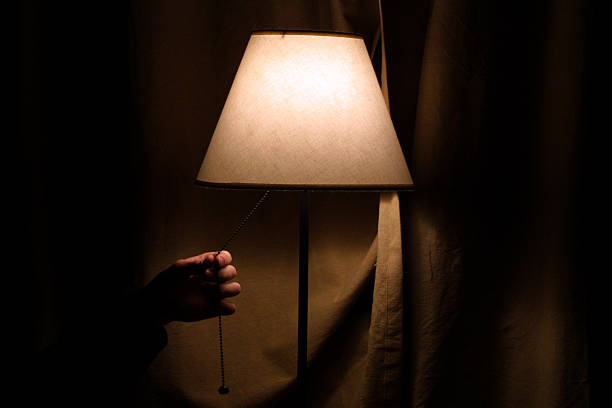
Result: While the total luminous flux remains unchanged, the brightness of the luminous surface (light intensity per unit area) is greatly reduced, thereby reducing the light stimulation received by the eyes.
Principle 2: Ingenious design of shading angle (anti-direct sunlight)
Working mechanism: This is the most direct anti-glare lampshade . The design of the lampshade or the internal structure of the lamp (such as the grille or honeycomb mesh) ensures that the user cannot directly see the high-brightness lamp beads when operating at a normal angle (such as sitting or standing).
result: The larger the shading angle (usually required to be above 45 degrees), the better the control of glare, and the more effective it is in preventing uncomfortable glare.
Principle 3: Deep tube anti-glare (deeply hidden light source)
Working mechanism: Anti-glare lampshade design commonly found in downlights and spotlights . The lamp is deep enough that the light source is “hidden” in the reflective cavity inside the lampshade .
Result: This design requires light to be reflected by the cavity before it can be projected, avoiding direct contact between the human eye and the light source and achieving an extremely low UGR value.
Principle 4: Microprism structure (precise light control)
Working mechanism: Some high-end anti-glare lampshades use a micro-prismatic structure. This structure can refract and guide light at the micron level , precisely controlling the projection angle of the light beam.
The result: light is focused on the area where it is needed, avoiding spillage into unnecessary angles and minimizing distraction to the eye.
Principle 5: Optimizing reflective coating (uniform reflection)
Working mechanism: The inner wall or lining of the anti-glare lampshade is usually coated with a high-quality matte or diffuse coating .
The result: This avoids harsh, focused mirror-like reflections of light, thus preventing disabling glare and ensuring that the light output is even and soft.
How to choose your eye protection lampshade? Practical purchasing criteria
When purchasing lamps, please consider the following points as hard indicators for choosing anti-glare lampshades :
Check the UGR value: Look for products with UGR < 19 (general office) or UGR < 16 (detailed work/reading) stated on the packaging.
Check the shading angle: Observe the lampshade design to ensure that the light source is sufficiently “hidden”. The ideal lampshade design should ensure that the human eye cannot look directly at the light source at an angle of more than 45 degrees.
Inner wall material: Choose a matte, frosted or anti-glare lampshade inner wall with a soft light structure , and avoid using high-gloss or mirror materials.
Pay attention to color: Although some dark lampshades can block glare, they may also cause low light efficiency and sacrifice brightness. It is important to ensure that while preventing glare , the brightness (lumens) still meets the space requirements.
in conclusion:
Eyes are the windows to the soul, and light is the nutrition of the eyes. Glare is like “noise” in the environment, which consumes your visual resources invisibly.
Choosing a high-quality anti-glare lampshade is not only about adding beauty to the space, but also a long-term investment in eye health. By softening and controlling light, it creates a high-quality visual environment, allowing you to enjoy comfortable and efficient lighting at home or in the office.
The next time you buy a lamp, ask yourself: Does my lampshade protect my eyes?