Chandeliers are the most dramatic and decorative form of lighting in a home. However, due to their suspended nature, weight and balance are often overlooked, yet crucial safety factors when purchasing. An unbalanced or underweight chandelier not only affects light projection but can also pose serious installation safety hazards.
The lampshade, the most striking component of a chandelier, has a material and size that directly determine its overall weight distribution. This article will provide a safety guide for choosing a chandelier from three perspectives: structural mechanics, balance principles, and load-bearing assessment . This guide will ensure your chandelier is both aesthetically pleasing and durable.
The basis of weight assessment: the contribution of lampshade material to the overall weight
The overall weight of a chandelier is made up of several parts, and the lampshade is often the largest contributor to the weight.
Measurement of lampshade material and weight
Heavy duty lampshade: Lampshades made of solid metal, thick glass, or crystal are the heaviest, especially in multi-layered crystal chandeliers or large glass chandeliers, where the total weight of the lampshade may account for more than 70% of the total weight of the lamp .
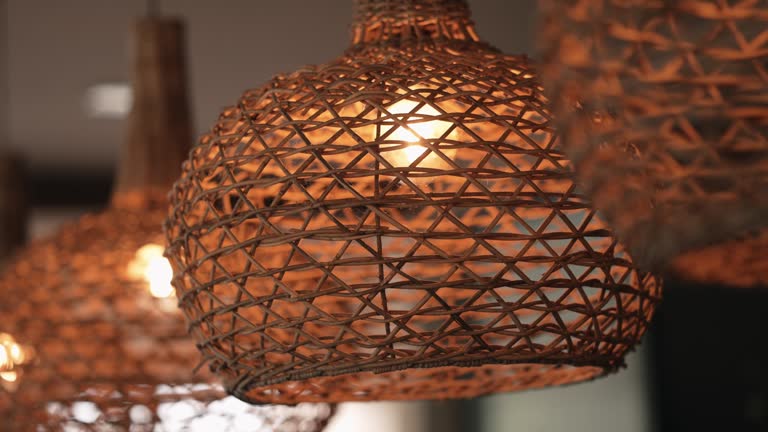
Lightweight lampshade: Lampshades made of materials such as fabric, paper, rattan or thin acrylic contribute less to the overall weight, but their structure (such as multi-layer frames) still needs to be carefully evaluated.
Safety reminder: When purchasing heavy-duty chandeliers (over 5 kg), the net weight of the fixture must be clearly identified and communicated to the installer so that the appropriate mounting hardware can be selected.
Overall weight evaluation formula
The total weight of a chandelier is equal to: the weight of the lampshade + the weight of the lamp body/frame + the weight of the hanging chain/rod + the weight of the transformer/ballast .
For heavy lamps, priority should be given to chandeliers with evenly distributed weight to avoid concentrating all the weight at the bottom of the lamp, which increases the difficulty of hanging.
Balanced mechanics: Avoiding a top-heavy lampshade design
A poorly designed chandelier may appear “top-heavy”, which not only affects the appearance but may also cause it to shake or even fall off.
Vertical Balance: Center of Gravity Considerations
Ideally, the center of gravity of a chandelier should be as close to or lower than the hanging point of the luminaire as possible .
Handling of heavy lampshades: If the lampshade is made of heavy material (such as cast iron or thick glass), the manufacturer will usually add a counterweight to the top connecting rod or ceiling cup to move the center of gravity upward to ensure that the lamp does not tilt when it is stationary and does not shake violently when the wind blows.
Structural balance: symmetry of a multi-headed lampshade
For multi-head hanging lamps (such as chandeliers), the weight and position of all lampshades must be strictly symmetrical . Any asymmetrical design will cause visible tilt after installation.
Buying tips: Shake the exhibit (under the premise of ensuring safety) and check whether the lamp can quickly return to a balanced state.
Load-bearing capacity assessment: ensuring installation safety is the lifeline
Even the most perfect chandelier requires a reliable load-bearing system. The load-bearing assessment is primarily divided into two parts: the load-bearing capacity of the ceiling structure and the load-bearing capacity of the fixture’s built-in hardware .
Ceiling structure load-bearing standards
Concrete ceiling: It has the strongest load-bearing capacity, but expansion screws or anchor screws are required for installation to ensure depth and firmness.
Drywall: It is strictly forbidden to install heavy chandeliers directly on gypsum boards.
Correct approach: You must find a wooden or steel keel behind the gypsum board and fix the weight of the chandelier directly to the main structure. If you can’t find a keel, you need to use professional through-wall expansion bolts to transfer the load point to the upper concrete floor.
Safety rule: Your ceiling’s load-bearing capacity should be at least 3 to 5 times the net weight of the chandelier to cope with impacts such as earthquakes, shaking or accidental pulling.
Load-bearing assessment of lamp hardware
Hanging rod/chain: Check the material and thickness of the hanging chain or hanging rod. Heavy chandeliers should use thick metal rods or reinforced chains , and their connecting threads and welds must be strong.
Canopy: The size and thickness of the canopy must be large enough to distribute the total weight of the luminaire. The screw holes should be clear and stable, and fit tightly against the ceiling.
Professional advice: For any chandelier weighing more than 5 kg , it is strongly recommended to hire a professional electrician or experienced structural engineer to install it and conduct a load-bearing test before installation.
Conclusion: Safety is the first aesthetic consideration when purchasing a chandelier
The aesthetic value of a chandelier lies in its light, suspended feel and unique play of light and shadow. However, this beauty requires absolute safety . When purchasing, consider beyond style and price and prioritize the shade material’s contribution to the overall weight, the fixture’s balance , and the load-bearing capacity of the installation location .
Make sure your chandelier is mounted on a solid structure so it can become a long-lasting, reassuring feature of your home.
Make “weight-bearing capacity assessment” the first task on your next chandelier shopping list!